The Problem That Started It All
Last year, on my way to Kasoa to visit family during the holidays, I witnessed something that still haunts me.
A man claiming to be a preacher boarded our bus and launched into a 30-minute sermon. I tuned out, scrolling through my phone - honestly, I hate these things. But when I finally looked up, I couldn't believe what I was seeing.
This man was now holding up a bottle of herbal medicine, asking passengers to raise their hands if they wanted to drink it. Hands shot up. He distributed disposable cups to those who responded, then walked around pouring the "medicine" into each cup like he was serving holy communion. And they drank it. Every single one of them.
He spent the next several minutes talking up the drug's benefits.
That's when it hit me: this stranger had just convinced people to consume an unknown substance - something he called medicine but could have been anything - and they'd accepted it willingly, trustingly. I watched a couple behind me give some to their little daughter, smiling as she swallowed.
Crazy!
I still can't wrap my head around it. The sheer trust these passengers displayed was terrifying. What if the concoction contained allergens? What if it had harmful substances? And if something went wrong, who would be held accountable?
It's deeply concerning when you think about it.
The Three-Party System That's Failing
When it comes to pharmaceuticals, I believe there are at least three critical parties involved: the regulatory body (the government), the manufacturer, and the end user.
The government sets the standards - defining what qualifies as legitimate medicine and establishing guidelines for manufacturing and distribution.
The manufacturer must follow these regulations to the letter while prioritizing customer safety.
The end user has a responsibility too: ensuring the drugs they consume are safe and won't cause unexpected side effects by verifying they meet regulatory standards.
When any one party fails in its duties, people get harmed. Sometimes fatally.
Ghana's Pharmaceutical Wild West
The nature of Ghana's pharmaceutical industry is deeply concerning. Meeting standards seems optional for some manufacturers.
Major companies like KinaPharma operate visibly - they must obtain FDA approval, conduct proper experiments, perform necessary trials, and maintain detailed records for auditing. They have to meet standards because they're in the spotlight.
But KinaPharma and other big manufacturers aren't the only pharmaceutical players in Ghana.
There's the "roadside herbal" lady who sits by the roadside with her small tray of herbs, roots, and concoctions. There's the one who carries her mixtures around, going door-to-door trying to make sales.
There's the woman my father took me to after I'd suffered a severe asthma attack - an attack so bad I genuinely thought I was dying. This woman claimed her herbal talents came from "mystical spiritual forces." She told us how she'd cured a certain girl of her asthma and promised to cure mine too.
She gave me a bitter, appetite-destroying, hope-in-life-losing herbal concoction to drink.
In case you're wondering: I'm still asthmatic.
Then there are those who sell drugs in vehicles - from dewormers to emergency contraceptive pills. Yes, I've actually seen someone selling morning-after pills in a trotro at a lorry station.
Recently, we've gained a new category: media personalities and influencers who sell or advertise drugs on TV and online, especially products claiming to make you successful, fight spiritual attacks, or control your partner.
Every Ghanaian knows this reality. Some recognize the danger it poses; others see no problem at all.
Yet the statistics are damning: in sub-Saharan Africa, falsified anti-malarials are linked to 267,000 deaths annually, and substandard antibiotics are a primary driver of antimicrobial resistance (AMR). Economically, these products drain the National Health Insurance Scheme (NHIS) and erode public confidence in the healthcare system.
When The Media Becomes Complicit: The MACOFA Exposé
In a controlled undercover operation, investigative reporters mixed three soft drinks - Malta Guinness, Coca-Cola, and Fanta - and labeled the concoction "MACOFA," claiming it cured infertility and impotence.
The team successfully registered a non-existent company called "Krodwoa Enterprise Limited" with the Traditional Medicine Practice Council (TMPC) without a physical inspection. Even more disturbing, eight prominent media houses accepted the product for advertisement without requiring an FDA approval certificate.
This exposed a massive failure in the watchdog role of Ghanaian media.
And here's the kicker: people actually called inquiring about the drug, wanting to buy it.
Read the full investigation here: https://thefourthestategh.com/2023/09/dangerous-endorsements-herbal-medicine-expose-in-ghana/
This exposé forced the FDA to clamp down on media advertisements of unapproved herbal medicines, emphasizing that Sections 100 and 144 of Act 851 prohibit advertising food or herbal products as preventives or cures for serious health conditions without clinical validation.
The Nibima Misinformation Case
During the COVID-19 pandemic, the herbal product "Nibima" (Cryptolepis sanguinolenta) became a focal point of public misinformation. While the FDA and researchers from KNUST approved the herb for Phase II clinical trials to evaluate its efficacy against COVID-19, viral social media posts falsely claimed it had been approved as a confirmed cure.
This kind of misinformation creates a dangerous environment where patients may abandon proven medical interventions in favor of unverified herbal remedies.
Enter MedVerify
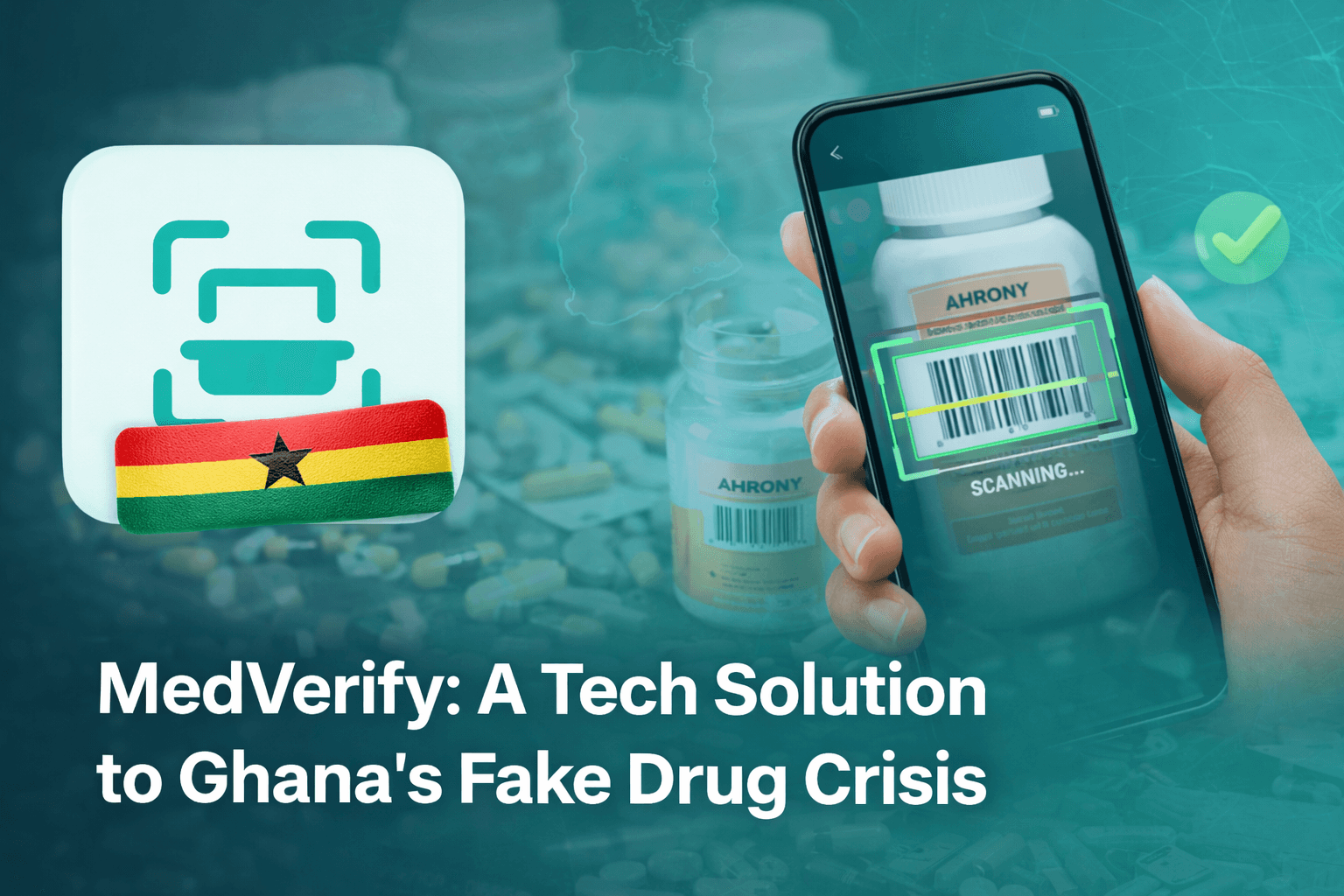
MedVerify is a mobile app I designed to verify the registration status of pharmaceutical products. Its main goal is simple: provide a reliable, easy-to-use interface for users to determine if a drug is officially registered with regulatory authorities, view its specific details, and report suspicious or counterfeit products.
Users can verify medications using:
- Barcode Scanning: Real-time scanning using their device's camera
- Manual Search: Text-based "fuzzy search" for drugs by name or registration number
- Image Upload: Capturing and uploading photos for verification assistance
System Architecture and Components
MedVerify is built on a modular architecture that includes:
- Mobile Application: A Flutter-based app for Android and iOS featuring offline history, real-time scanning, and location services for geographic data analytics
- Backend API: A FastAPI-based system handling requests, input validation, and database communication
- Automated Scraper: A Selenium-based scraper that automatically fetches and updates product data from the Ghana FDA public database
- Admin Dashboard: A web interface for administrators to monitor statistics, view user feedback, track failed scraping attempts, and analyze regional data
Monitoring and Analytics
Beyond simple verification, MedVerify tracks the prevalence of suspicious drugs through:
- Analytics and Heatmaps: The system tracks product scans with location-based data to visualize where unregistered or suspicious products are appearing, using Firebase Analytics with BigQuery and Looker Studio
- Feedback System: Users can submit reports and attachments regarding issues they encounter
- Notification Service: Infrastructure for sending push notifications and alerts to users
The Community Support System
To enhance the service MedVerify provides, users can contribute to the application by uploading images of drugs, barcodes, and prices after verification. Users can also specify where or from whom they purchased the drug to aid in analytics.
How MedVerify Addresses The Problem
MedVerify aligns closely with strategic interventions recommended for Ghana's pharmaceutical landscape. Here's how:
Strengths and Alignment with Best Practices
Path to WHO Maturity Level 4: To reach the highest level of regulatory excellence, Ghana needs electronic tracking systems and proactive publication of assessment reports. MedVerify provides a consumer-facing version of such a system.
Combating Misinformation: Cases like "Nibima" demonstrate how misinformation leads patients to use unverified remedies. MedVerify provides a source of truth by linking directly to official regulatory data.
Accessibility in Low-Resource Areas: By offering offline history and local storage, the app remains functional in areas with poor internet connectivity.
Addressing Economic Incentives: High out-of-pocket spending drives consumers to cheaper, unregulated sources. MedVerify offers a free way for these consumers to verify the quality of cheaper alternatives before consumption.
Potential Limitations
Data Quality Dependency: MedVerify is only as effective as the underlying Ghana FDA database. If the official portal isn't updated, the scraper cannot provide accurate data.
The "Substandard" vs. "Falsified" Gap: While the system can identify "unapproved" products (those not in the database), it can't detect "substandard" products - authorized drugs that have degraded due to poor storage conditions (like heat exposure) - unless they've been officially recalled and updated in the system.
Bypassing Regulatory Capture: The MACOFA case exposed institutional failures and potential regulatory capture. While MedVerify increases transparency, it still relies on the integrity of the initial registration data provided by the FDA.
Conclusion
MedVerify is a robust technological intervention that addresses the complex drug quality crisis in Ghana. It puts verification power directly into the hands of the public.
The bus incident in Kasoa showed me how vulnerable people are - how easily trust can be exploited when information isn't accessible. MedVerify aims to change that, one scan at a time.