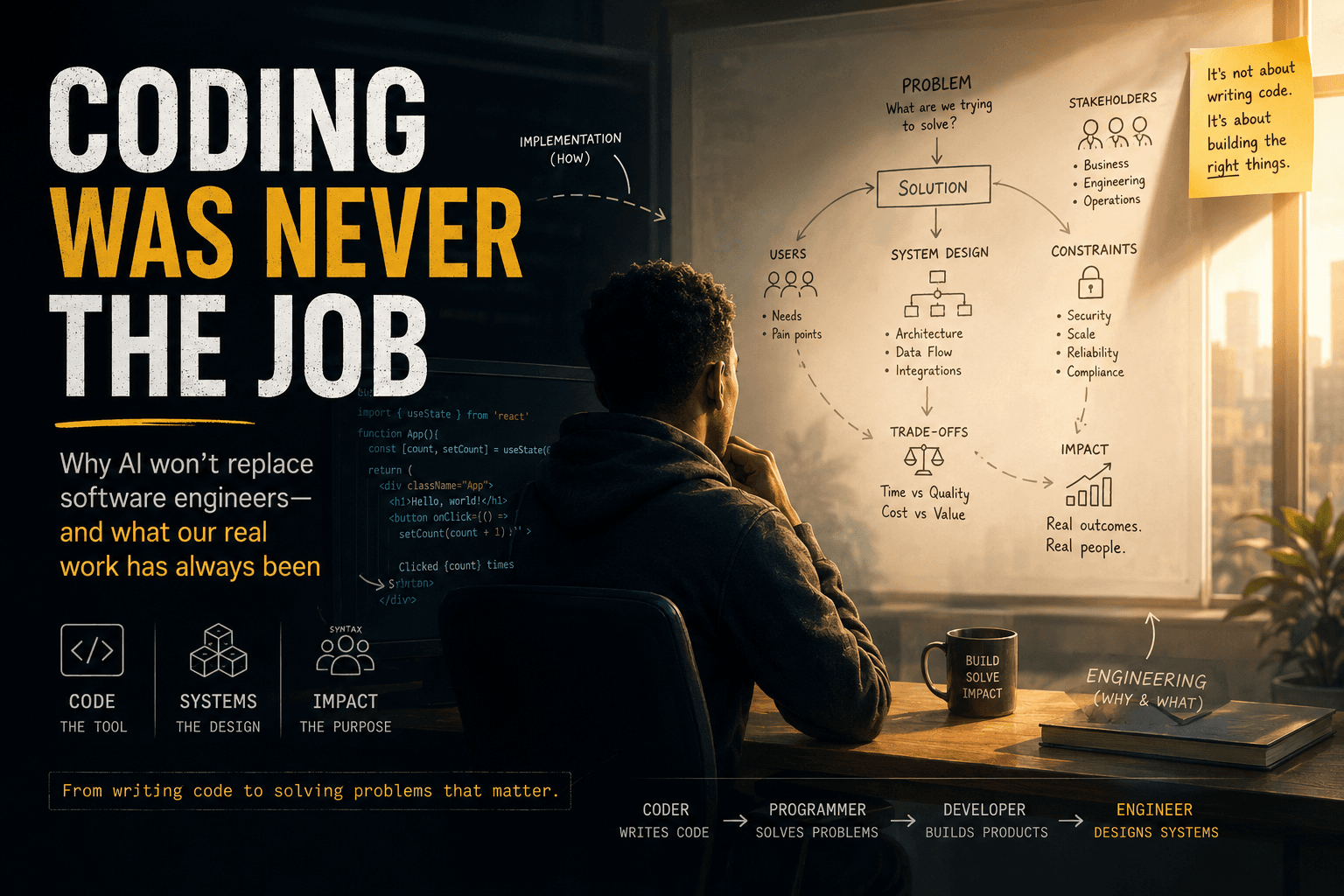
There's a panic spreading through tech right now. GitHub Copilot finishes your sentences. Claude writes entire modules. Cursor refactors your codebase while you sip coffee. And somewhere in the middle of all this, a question has started echoing louder and louder:
Is software development dead?
I want to sit with that question for a moment, not to dismiss it, but to trace it back to its root. Because the anxiety is real. But what it actually reveals isn't a threat to the profession.
It reveals a misunderstanding about what the profession ever was.
Who We Think We Are
Let's start with something simple: what do we actually call ourselves?
There's coder. Programmer. Developer. Software engineer. Most people use these interchangeably, and most people are wrong to do so, not because the distinctions are rigid, but because the progression between them tells a story.
A coder writes syntax. They make the computer do something. Given a clear instruction, they can express it in a language a machine understands. That's a skill. But it's a narrow one.
A programmer solves problems with code. They think about logic, about efficiency, about what happens when the input isn't what you expected. The medium is still code, but the thinking has expanded.
A developer builds things. They take ownership of a feature, a product, a system. They care about whether it actually works for the person using it, not just whether it compiles.
A software engineer thinks in systems. They ask: what happens at scale? What happens when this fails? Who maintains this in two years? What are the trade-offs between this approach and that one? They see the whole: the architecture, the lifecycle, the humans on both ends of the screen.
Here's what's interesting about that progression: it has almost nothing to do with how well you write code.
It has everything to do with how far your thinking reaches.
And this is why so many people misunderstand what software engineering actually is.
Early in our careers, most of us spend the majority of our time implementing clearly defined tasks. We naturally begin to associate the profession with typing code because that's the layer we're interacting with most often.
But as responsibility grows, the work shifts upward.
You begin thinking less about syntax and more about systems.
Less about functions and more about trade-offs.
Less about implementation and more about architecture, reliability, scalability, communication, and product decisions.
The farther you progress in software development, the less the profession resembles typing and the more it resembles systems thinking.
The Shift That's Always Been Happening
Here's something the AI panic forgets: the abstraction layer in software has been rising for as long as software has existed.
Programmers once wrote in machine code, raw binary, 1s and 0s. Then came assembly language, which let you write human-readable mnemonics instead. Then high-level languages like FORTRAN and COBOL, which let you express ideas closer to how humans think. Then object-oriented programming, which let you model the world. Then frameworks, which let you skip entire categories of solved problems. Then cloud platforms, which let you rent infrastructure instead of building it.
Every single one of these transitions could have triggered the same panic.
"If we have FORTRAN, do we still need assembly programmers?"
And the answer, every time, was the same: the role didn't die, it transformed.
The thinking moved up the stack.
Engineers stopped worrying about how to manage memory and started worrying about how to model business domains. They stopped hand-configuring physical infrastructure and started thinking about distributed systems, deployment reliability, and scalability.
They didn't become less valuable.
They became more valuable because their thinking could now operate at a higher level.
AI coding tools are not a rupture in this history.
They are the next line in a very long story.
Engineering Is The Management of Abstraction
The deeper pattern here isn't really about AI.
It's about abstraction.
Software engineering has always been the discipline of managing complexity through layers of abstraction.
Every major advancement in computing has done the same thing:
- Assembly abstracted machine code
- High-level languages abstracted assembly
- Frameworks abstracted repetitive implementation
- Cloud platforms abstracted infrastructure
- No-code tools abstracted software assembly
- AI abstracts portions of implementation itself
Each abstraction removes friction from lower-level work.
But something interesting happens every time:
The importance of higher-level thinking increases.
When implementation becomes easier, the bottleneck moves.
Suddenly the difficult questions become:
- What should we build?
- How should systems interact?
- What are the trade-offs?
- What happens when things fail?
- How do we ensure maintainability?
- How do we align technical decisions with human needs?
Complexity never disappears.
It simply moves upward.
And software engineering has always been about navigating that complexity.
The No-Code Proof
But we don't even have to reach that far back for evidence.
No-code tools have existed for decades. WordPress. Wix. Bubble. Webflow. Squarespace. These platforms let non-technical people build things that previously required a developer. Websites. Landing pages. E-commerce stores. Internal tools. Entire startups.
Did they kill software development?
No.
They shifted it.
Developers stopped spending time hand-coding things that had already been solved and started spending time on the problems that hadn't been.
They used no-code tools themselves when those tools were the right instrument for the job.
A software developer who builds a client's marketing site on Webflow in a day isn't failing at their job.
They're excelling at it.
They chose the right tool for the problem.
This is the point people miss:
A software engineer who uses a no-code tool is still a software engineer.
The discipline isn't defined by the instrument.
It's defined by the thinking.
AI coding tools are no different.
They are, in the most precise sense, a higher-level abstraction over the act of writing code.
A developer who uses Copilot to generate a boilerplate API isn't being replaced.
They're doing what engineers have always done: reaching for the best available tool and spending their thinking on what actually matters.
A Real Example Of What Software Engineering Actually Looks Like
One of the clearest examples of this for me came while designing a distributed health information routing system intended for environments with unreliable internet connectivity.
At first glance, someone from the outside might reduce the project to something simplistic:
"You built a health service."
But that description misses almost everything that made the work difficult.
The real challenge wasn't writing endpoints.
It was designing a system that could continue functioning even when the environment itself was unreliable.
The problem space immediately expanded beyond code.
Healthcare facilities in many regions operate with intermittent connectivity, unstable infrastructure, constrained bandwidth, and fragmented systems. Traditional centralized architectures become dangerous in these environments because a network outage can effectively halt communication between facilities.
So the core engineering question became:
How do you design a distributed system that remains operational even when the network itself cannot be trusted?
That question led to an entirely different set of concerns.
Not syntax concerns.
Systems concerns.
The breakthrough didn't come from looking at traditional enterprise architecture manuals. It came from looking at how people share files on mobile phones in resource-constrained environments. It came from Xender.
Xender doesn't care about stable internet or centralized cloud servers. It bypasses infrastructure entirely by spinning up localized, ad-hoc peer networks to move massive amounts of data reliably.
I realized that if we applied that exact same mental model to healthcare systems, we could flip the entire paradigm on its head.
The architecture evolved into a distributed edge-routing model where each facility operates its own local router capable of:
- local message queuing
- offline persistence
- retry handling
- audit logging
- dynamic routing
- transformation pipelines
- and secure peer-to-peer communication
The central platform wasn't responsible for processing every request directly.
Instead, it acted more like a coordination and governance layer:
- maintaining service discovery,
- distributing configuration,
- enforcing policy,
- validating cryptographic signatures,
- and aggregating audits.
Immediately, the engineering challenges multiplied.
Should routing decisions happen centrally or locally?
How do you synchronize configuration securely?
What happens when a facility loses connectivity for several hours?
How do you prevent duplicate message delivery?
How should retries behave under unstable networks?
How do you establish trust between nodes?
How do you guarantee audit integrity in healthcare environments?
How do you maintain interoperability between systems using different standards?
None of those problems are fundamentally coding problems.
They're architecture, reliability, governance, and systems-design problems.
Even the choice of PostgreSQL wasn't simply a database preference.
It was a reliability decision.
The local queue needed transactional guarantees because healthcare messages couldn't simply disappear during outages. Audit logs needed immutability. Edge routers needed local persistence strong enough to survive unstable connectivity.
The difficult part wasn't writing a queue consumer.
The difficult part was understanding the operational environment deeply enough to make the right trade-offs.
And that's what software engineering actually looks like in practice.
Not merely translating instructions into syntax.
But understanding real-world constraints deeply enough to design systems that continue functioning despite them.
What AI Actually Replaces
To understand why software engineering isn't threatened, you have to understand what AI coding tools actually do.
They are extraordinarily good at syntax. At patterns. At taking a well-specified intent and expressing it correctly in a programming language.
They can write a sorting function, scaffold a React component, generate a SQL query, explain an error message, or refactor repetitive boilerplate.
What they cannot do is decide what to build.
They cannot understand why users keep abandoning a checkout flow at step three.
They cannot weigh the trade-off between a solution that ships in two weeks and one that will still be maintainable in two years.
They cannot walk into a room of stakeholders with competing interests and find the version of a feature that actually solves the underlying problem.
They cannot think in systems because systems exist inside contexts:
- business contexts,
- organizational contexts,
- human contexts,
- operational contexts.
And navigating those contexts requires judgment, not just pattern matching.
The part of software engineering that AI automates is, bluntly, the least interesting part.
The mechanical translation of a decision that's already been made into code that expresses it.
The scaffolding.
The boilerplate.
The first draft.
The part that remains, the thinking, was always the real job.
Coding Was A Means, Not The End
This is where I want to make a claim that might sound strange at first:
Software engineering doesn't exist because of coding. Coding exists because of software engineering.
Think about what that means.
We didn't discover code and then wonder what to do with it.
We had needs:
- to automate processes,
- to process information,
- to coordinate systems,
- to scale human capability,
- to solve problems.
That need existed before the tool.
We created the tool to serve the need.
Coding, in this light, is not the discipline.
It's the current best instrument for expressing the discipline.
It's the hammer in the carpenter's hand.
The carpenter doesn't become irrelevant when someone builds a better hammer.
They pick it up.
And they keep building.
The discipline of software engineering, the practice of taking human problems and designing systems to solve them reliably, scalably, and maintainably, exists independently of any particular language or tool.
It existed before Python.
It will exist after whatever comes next.
And if one day software is built entirely through diagrams, natural language, visual systems, or neural interfaces, software engineering will still exist.
Only the implementation medium will have changed.
Who Should Actually Be Worried
I want to be honest here, because the answer isn't nobody.
If your entire value as a developer has been the ability to type code faster than average, if you've never thought deeply about why you're building what you're building, or how the pieces fit together, or what happens when something goes wrong, then yes, that specific skill is being automated.
But this is not a eulogy for a profession.
It's a call to inhabit it more fully.
The engineers who will thrive in this new environment are the ones who were always asking the questions that code alone couldn't answer.
The ones who understood that writing code was a way of expressing decisions, not the source of the decisions themselves.
And for those earlier in their careers, this is actually good news.
The path from junior developer to senior engineer has always been about learning to think at higher levels of abstraction.
AI tools compress the amount of time spent on lower-level implementation.
That's not necessarily a threat.
It can also be an accelerant.
What Engineering Actually Is
So what is software engineering, stripped of the code?
It is the practice of understanding human problems deeply enough to design software systems that solve them.
It is the discipline of making decisions under uncertainty:
- architectural decisions,
- operational decisions,
- product decisions,
- scalability decisions,
- security decisions,
- maintainability decisions.
It is the responsibility of thinking ahead.
Of anticipating failure.
Of balancing trade-offs.
Of considering the people who will use what you build and the people who will maintain it after you're gone.
It is, at its core, a way of thinking.
Code is simply how that thinking gets expressed today.
AI is changing how fluently and how quickly that expression happens.
But the thinking itself remains stubbornly, irreducibly human.
A Different Question
The question "is software development dead?" is the wrong question.
It was always the wrong question.
The right question is:
What was software development, really?
It was never about the code.
It was about the problems.
It was about the systems.
It was about the judgment required to navigate the space between a human need and a working solution.
That space hasn't gotten smaller.
If anything, as AI makes software faster and cheaper to build, the demand for people who can think clearly about what to build, and why, is only going to grow.
The abstraction layer rose again.
The tools evolved again.
And just like every transition before it, the role of the engineer did not disappear.
It moved upward.
The hammer got better.
The architect became even more necessary.
Want to see this thinking in practice? > Read my full architectural breakdown, comparative research, and implementation blueprint for this exact edge-routing platform in the case study: > Building a Health Data Router That Works When the Internet Doesn’t